
You've decided to invest in a rug. You've measured your room, you've chosen your colour palette, and you're ready to buy. Then you see the labels: hand-knotted, hand-tufted, machine-made, flatweave, hand-loomed. Suddenly, a simple purchase becomes a confusing exercise in textile terminology.
Here's the problem: most rug retailers use these terms loosely, and some use them interchangeably — which is misleading, because the differences between these construction methods are enormous.
Hand-Knotted Rugs: The Gold Standard
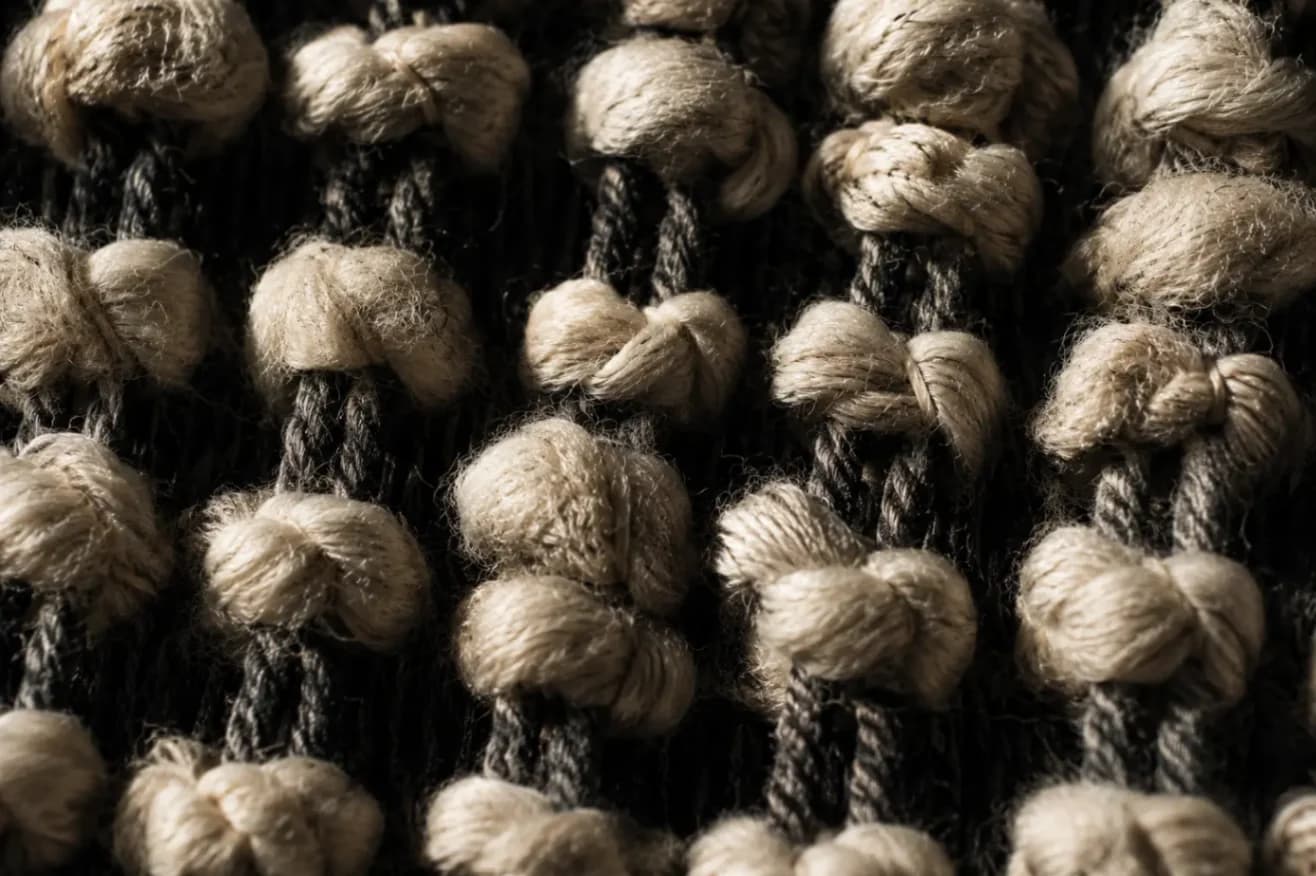
A hand-knotted rug is the pinnacle of rug craftsmanship. It is not a product. It is a piece of art, made by human hands, one knot at a time.
How They're Made
A skilled artisan works on a vertical loom, tying individual knots around the warp threads. Each knot is tied by hand, cut to length, and compacted with a comb. There is no machinery involved.
A single hand-knotted rug can contain anywhere from 40 to 400+ knots per square inch (KPSI). A 6×9 foot rug with 100 KPSI contains approximately 780,000 individual hand-tied knots. At a rate of roughly 8,000-10,000 knots per day, that single rug takes approximately 3-4 months to complete.
How to Identify One
Turn the rug over. On a genuine hand-knotted rug: the pattern on the back will be a slightly less defined mirror of the front; you'll see slight irregularities — proof of human handiwork; there will be no backing material; and the fringe is a structural extension of the warp threads, not sewn or glued on.
Key Characteristics
Durability: Extremely high — lasts 50-100+ years with proper care Feel: Dense, substantial. Develops a beautiful patina over time Shedding: Moderate initially, subsides within 3-6 months Repair: Fully repairable — individual knots can be replaced Value: Appreciates over time. Antique pieces are collector's items Price Range: ₹15,000 – ₹5,00,000+ depending on size, material, and KPSI
The Bhadohi Heritage
India's hand-knotted rug tradition is centred in Bhadohi, Uttar Pradesh — often called the "Carpet Capital of the World." The region has been producing hand-knotted rugs for over 500 years. Reknott's own manufacturing heritage of over 60 years is rooted in this very tradition.
Hand-Tufted Rugs: The Middle Ground
Hand-tufted rugs occupy the middle territory between handmade artistry and industrial efficiency.
How They're Made
A craftsperson uses a handheld tufting gun — a device that punches yarn through a pre-drawn canvas. After tufting, a secondary backing is glued to the back using latex adhesive. A hand-tufted rug of the same size that takes 3 months to hand-knot can be completed in 1-2 weeks.
How to Identify One
The back will be covered with a fabric backing. The fringe, if present, is sewn on — decorative, not structural. The rug will feel lighter and less dense than a hand-knotted piece.
Key Characteristics
Durability: Moderate — lasts 10-20 years Shedding: Higher than hand-knotted, can continue for months Repair: Difficult due to latex backing Value: Depreciates — no resale or collectible value Price Range: ₹5,000 – ₹80,000
The Latex Problem
Over time — typically 7-15 years — the latex dries out, cracks, and crumbles. The rug loses its pile and the backing disintegrates into a powdery residue. This is particularly problematic in India's humid climate, where cities like Mumbai, Chennai, and Kolkata accelerate latex degradation significantly.
Machine-Made Rugs: The Mass-Produced Option
Machine-made rugs are produced entirely by automated power looms. The entire process takes hours, not months. A factory can produce hundreds of identical rugs per day.
Key Characteristics
Durability: Low to moderate — 3-10 years Feel: Thin, uniform, lacks character Repair: Not repairable — must be replaced Value: Zero resale value Price Range: ₹1,000 – ₹25,000
The Real Cost Comparison
This is where most buyers make a critical error: they compare the upfront price instead of the cost per year of use.
Machine-Made (₹8,000): Lasts ~5 years. Cost per year: ₹1,600/year. Hand-Tufted (₹25,000): Lasts ~12 years. Cost per year: ₹2,083/year. Hand-Knotted (₹60,000): Lasts ~80 years. Cost per year: ₹750/year.
The hand-knotted rug — the most expensive upfront — is actually the cheapest option over its lifetime by a significant margin. And unlike the other two, it can be passed down as a family heirloom.
What About Flatweave, Dhurrie, and Kilim Rugs?
These are lightweight, reversible, durable, easier to clean, and ideal for dining rooms, kitchens, and outdoor-adjacent spaces. Indian dhurries are a celebrated textile tradition — a well-made cotton or wool dhurrie can last 20-30 years with proper care.
Which Type Should You Buy?
Choose Hand-Knotted if you want a rug that will last a lifetime, you value craftsmanship and uniqueness, and you see a rug as an investment.
Choose Hand-Tufted if you want the look of handmade at a lower price point and you're furnishing a space for 5-10 years.
Choose Machine-Made if you need something temporary, for a rental property, or plan to replace it within a few years.
How to Verify What You're Buying
- 01Always check the back — hand-knotted shows knot structure; hand-tufted has fabric backing; machine-made has a uniform grid
- 02Check the fringe — structural (hand-knotted) vs glued/sewn (others)
- 03Ask for the KPSI count
- 04Buy from the source — brands like Reknott that manufacture in Bhadohi eliminate mislabelling risk
Final Thought
A machine-made rug says "I need something functional right now." A hand-tufted rug says "I want something nice within a budget." A hand-knotted rug says "I believe in craft, I invest in quality, and I want something that will outlive me."